
Protect. Preserve. Restore.
Annual Report 2025
Cape Cod Commission Pond Data Portal
The Cape Cod Water Quality Data Portal is a map-based viewer that allows users to explore freshwater and marine water quality data compiled by the Cape Cod Commission for regional partners. Data and trends can be viewed by monitoring site, pond, or embayment. The freshwater pond portal can be viewed by clicking on this url https://waterquality.capecodcommission.org/pond, and information can be searched by pond name, pond location, and through navigation of the interactive map. The database can provide spatial and temporal trends from specific monitoring programs and pond locations.
Saving Our Ponds Film Series
In collaboration with the Woods Hole Center for Oceans and Human Health, the Great Pond Foundation, APCC, and Circuit Arts, Falmouth Water Stewards assisted in the production of high-quality films on cyanobacteria monitoring, OLAUG activities, and other activities to foster pond protection. The films can be viewed on https://www.youtube.com/playlist?list=PL1CGd4Scv4GJ3k-s7UPgk-3mKIaAIEeNX. New films are in production and will be added in 2026.
Woods Hole Science Stroll
The Woods Hole Science Stroll is a fun summer event that celebrates the world-class scientific and environmental organizations in Woods Hole and the Falmouth community. The event was held on Saturday, August 9th, and featured family friendly hands-on activities and opportunities to learn about Woods Hole’s six major science institutions, the U.S. Coast Guard, and local environment and education-focused nonprofits.
This year, FWS distributed information on Falmouth’s drought conditions, trying to raise awareness about Town and State regulations, and to encourage water conservation. We also provided information on the importance of native plants in our ecosystem, and highlighted collaborative work with the Association to Preserve Cape Cod (APCC) on monitoring the Cape’s fresh water ponds. Thanks to the Bicycle and Pedestrian Safety Committee and Eversource, we were able to distribute water bottles with a full list of the Falmouth water stations printed on the side. Many lucky young visitors received a copy of A Guide to the Best Ponds on Cape Cod AND the Best Ways of Preserving Them, written and illustrated by FWS Board member Susan Baur. Two additional FWS Board members represented their respective organizations – Carmela Mayeski from Falmouth Public Schools, and Jennie Rheuban from WHOI Sea Grant were both on duty throughout the day.
Retirement of Mark Kasprzyk
After 27 years of service to the Town of Falmouth, in both the Conservation Department and the Department of Marine and Environmental Services, we want to honor Mark Kasprzyk for his dedication to our community and his impact on enhancing and conserving valuable environmental resources. The Little Pond Conservation Area is an excellent example of Mark’s contribution to the Falmouth community. By removing invasive plant species, replacing them with native species, restoring habitat, and creating walking paths, Mark transformed the property to a natural haven for all to enjoy. Mark was also a Board Member of the Falmouth Commodores, and served as President from 2016 to 2020. These are just a few examples of Mark’s service to the Falmouth community, and we applaud his contributions that enrich our lives. Congratulations, Mark!
President’s Message
- Cyanobacteria monitoring in Falmouth ponds continues in collaboration with APCC from the end of May to early
November. - The Cape Cod Commission launched the Cape Cod Water Quality Data Portal for both marine and freshwater ponds
https://www.capecodcommission.org/our-work/cape-cod-waterquality-data-portal/ - FWS Awards $500 Scholarships to High School Science Fair Students
The recipients are Torsten Houtler Falmouth Academy, for his project “The Effects of Different Types of Fertilizers on Zebrafish”; and Jack Beardsley and Russell Lavery Van Parijs, Falmouth High School for “Airborne Microplastics and Microfibers: Where Are They Hiding?” Congratulations, Torsten, Jack, and Russell! - OLAUG Founder Susan Baur has been selected as one of 50 visionaries of 2025 by the Explorers Club (EC50)
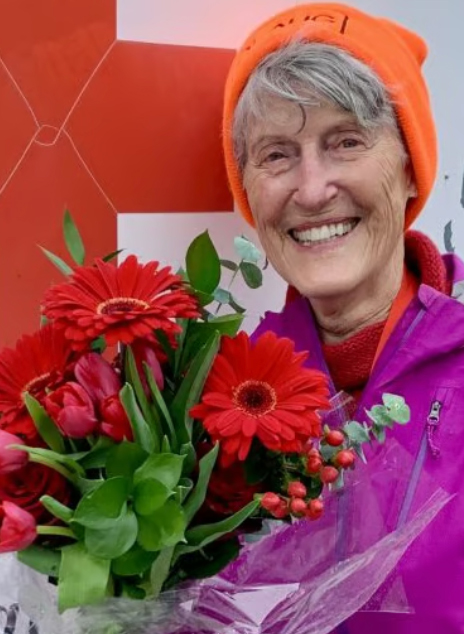
OLAUG Founder, Susan Baur
Falmouth Pond Atlas
With support from the Woods Hole Foundation, FWS volunteers surveyed 36 Falmouth ponds, rivers, and streams to assess water quality characteristics during both summer and winter. Runoff of plant nutrients (nitrogen, and phosphorus) from land degrades the quality of surface waters. These impacts include excessive growth of algae, periodic low oxygen, and blooms of potentially harmful cyanobacteria. While nitrogen largely drives water quality declines in coastal salt waters, both nitrogen and phosphorus contribute to water quality decline in fresh waters.
Results from the summer sampling revealed five concerns:
(1) Nitrate is high in rivers and low in ponds; this is expected, as rivers are carrying groundwater that is enriched in nitrate from septic systems. Plankton and submersed plants growing in summer take up nitrate and ammonium.
(2) Most ponds had low levels of ammonium and nitrate (inorganic and available) nitrogen; exceptions seemed to be Siders Pond (a unique pond due to its salinity profile), and Deep Pond that had higher nitrate levels than other ponds. It is likely that pond nitrogen is mostly low but occasionally high when a phytoplankton bloom ends (it did not have particularly high chlorophyll).
(3) Some ponds were particularly notable for high chlorophyll: Wings, Punch Bowl, Shallow, and Mill ponds in Woods Hole and East Falmouth.
(4) Phosphate was low almost everywhere, but highest in the two Mill Ponds.
(5) Temperature and dissolved oxygen profiles in all but the very shallowest ponds were highly stratified and hypoxic or anoxic in the bottom water, and thermoclines were observed at 5 to 7 meters. In contrast, winter sampling revealed well-mixed water columns at all sites.
All results from the Falmouth Pond and Stream Survey will be published in the FWS Pond Atlas that will be distributed during Spring 2026.
Winter and Summer profiles for each sampling location will be included.
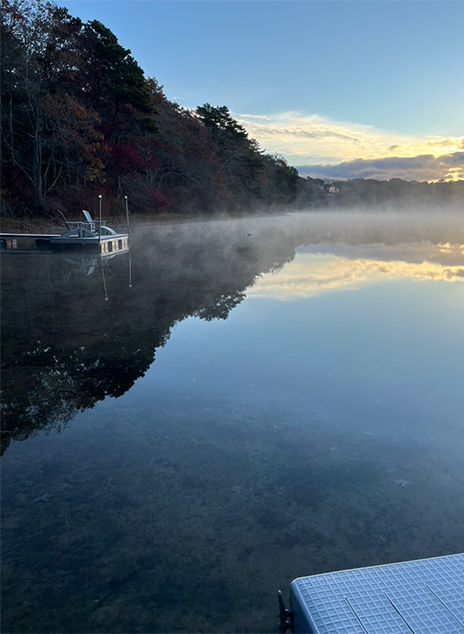
Mares Pond, Summer 2025
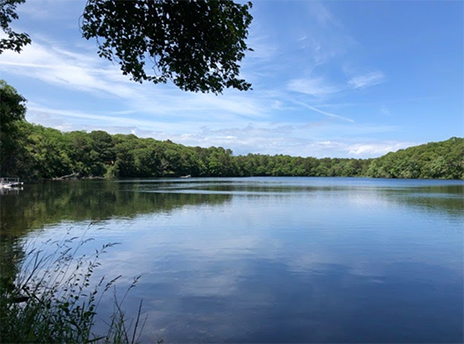
Fresh Pond, Summer 2025
Old Ladies Against Underwater Garbage Clean Falmouth Ponds
Working closely with the Falmouth Water Stewards to keep Falmouth’s swimming ponds free of trash, members of OLAUG removed garbage from five local ponds in 2024, five again this year, and will clean six in 2026. Susan Baur leads the group and estimates that OLAUG has removed close to 6,000 pounds of trash from ponds across Cape Cod during its eight year history. Each season thirty women, aged 65 to 85, dredge up more tires, boat- and car-parts, pipes, bottles, cans, lures and broken glass than the year before.
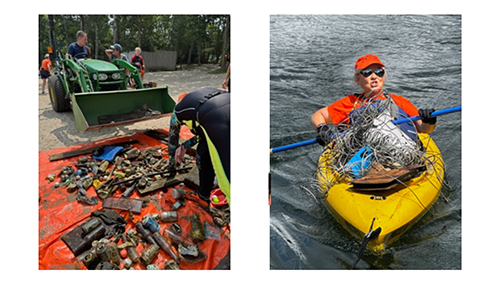
One of last summer’s most productive dives was the July clean up of Grews Pond in Goodwill Park. Enlisting the help of Scouts to clean the shoreline, OLAUG brought in scores of beer cans, several tires, fishing lures, toys, goggles, and pressure treated lumber. Onlookers saw for themselves how much stuff is thrown into ponds. Earlier in the season OLAUG cleaned Crooked, Mares, Flax, and Jenkins Ponds where one of the divers found a hand gun. Before turning it into the police, someone had the good sense to see if it was magnetic. The gun was, in fact, a tin replica of a sixshooter, manufactured by a toy company that has not been in business for sixty years.
Because we clean Jenkins Pond every year, we are bringing up older and older trash. Antique beer bottles left by ice fishermen are appearing along with an old frying pan and the head of a baby doll. We never know what we’ll find.
Although Falmouth has 27 Great Ponds of more than ten acres, fewer than fifteen are swimmable. Aquatic plants clog some, high levels of PFAS or forever chemicals render others unsafe for prolonged exposure. Like FWS, OLAUG is committed to keeping as many ponds as possible safe and clean.
Educational Programs in Falmouth Public Schools
Carmela Mayeski leads educational programs that introduce students to the rich ecological habitats in Falmouth. One example is the Coonamessett River. In five locations along the banks of the Coonamessett River, students pull on boots and waders to become detectives. They are looking for clues to solve the mystery of whether or not the river is healthy. Their preparation as river scientists actually began 6 months earlier, when they were in the fourth grade. Students from Falmouth’s four elementary schools visited the Coonamessett Greenway to learn why the river required restoration. As they hiked the lower watershed, they observed hills and mounds, curves and vernal pools that were put in by the scientists and engineers who orchestrated the restoration.
Students eagerly counted the small dark heads and shiny shell backs of turtles in Turtle Pond, experienced how herring are tagged and counted, and felt first hand (or in this case, first foot) the force of the current that these fish must navigate against to spawn in the freshwater ponds connected to the ocean by the Coonamessett.
In the fall of the same year, having moved on to grade 5, students are back in the river again. This time, they’re looking for evidence of the watershed’s health. Students observe the biodiversity of the area’s plant life (much different than when cranberry bogs stretched as far as the eye could see) and make physical observations of the river’s banks, bed, and channel. Using plastic test tubes, droppers, thermometers, and Secchi disks from a testing kit, they measure the water’s pH, phosphate, and nitrate levels as well as its dissolved oxygen, temperature, and transparency (turbidity). It’s always a tough challenge to choose from the many willing volunteers, the lucky student who gets to drop an orange from one of the several bridges on the river and its tributaries to measure the flow rate of the water. Once those tests and observations are made, it’s time for a favorite student adventure – the search for macroinvertebrates and other creatures living in the different environments within the Coonamessett. In boots, crocs, waders, and sometimes sneakers, students tread gleefully through the water with nets of all sizes to see what they can find.
As fun and exciting as this foray into the depths is, it has an important purpose. Students discover that the different types of organisms they find can tell them about the health of the water. Finding Stone, Dobson, or Alder fly larvae tells us that the water is likely clean as these creatures are highly sensitive to pollutants. Caddisflies, water pennies, Dragon, May, and Damselfly larvae wiggling inside the students’ nets are also welcome indicators that pollution levels are low. Students continue to explore, with each fresh net full of water and muck, the chance to make a new discovery. Much like a summer trip to the beach, it’s hard to get the kids out of the water. Having dried off and warmed up back in their classrooms, students share and analyze their data to determine whether or not the hypotheses they created are supported or disproven. They discuss what they found and what it tells them about the current health of the Coonamessett. And equally as important as their scientific learning, our students get a chance to be in nature. They learn that rivers are living ecosystems that can be healthy or unhealthy and that a group of determined people can do amazing things to help restore our local ecosystems.
Find more details at https://www.crivertrust.org/education-programs.
A Friend of Cedar Lake
Joyce Bock, sipping her coffee on a cool summer morning, looked out over her beloved Cedar Lake, and didn’t like what she saw. Lily pads covered the water just to the right of where they kept the family canoe. The one that had carried them over the pond for so many years. The lily pads were so mature that they presented trunks the size of tree limbs across the surface.
But stretching out beyond the pads was a haze above the water created by thousands of tiny white flowers sitting on stems a few inches above the surface. Kayakers and swimmers knew these were the surface presentation of an insidious plant that consumed the entire volume of the pond. A paddle made little progress in this mat. There was no visibility left for guiding swimmers, let alone clear water to pull through. But what was the mysterious plant? The necklace of homes around the pond had contributed nutrition for the aquatic intruders from septic systems and cesspools, road runoff, and fertilizer.
Falmouth Water Stewards had recently embarked on a stronger focus on fresh water in town, having previously spent a great deal of their energy on our saltwater estuaries and ponds. Joyce attended a meeting near her home organized by FWS to discuss freshwater ponds and the role of citizen science in gathering information about the health of our kettle holes.
Joyce would later invite the two presenters, one of whom would found OLAUG, to a December meeting in her living room with friends and neighbors who shared her love of Cedar Lake. Joyce’s message was simply put: we have a problem in the pond, and we need to do something. And something they did. Several neighbors pooled many thousand dollars to begin abatement of the invasive plants. One of the ideas put forward was to rent or buy a harvester that could mow the pond.
Meanwhile, Joyce attended a lesson on invasive plants sponsored by FWS and presented by excellent botanists from the Department of Environmental Protection. Here she learned that the insidious plant was fanwort, a South American native brought here to green up aquaria, liked because it could grow rapidly in the sparest of water environments. Somehow the plant had found Cedar Lake and taken over. The most important thing Joyce learned was that fanwort should not be harvested. Little pieces of the plant would generate new plants, so mowing fanwort would only increase its numbers. It needed to be treated with chemicals.
Joyce and her neighbors started a non-profit (https://www.friendsofcedarlake.org/), hired lake management professionals, got approval from the Town of Falmouth, and started the remediation of fanwort. Falmouth Town Meeting later approved a budget for future remediation as needed, propelled in part to protect a larger investment in the herring ladder out of Rand Canal. The remediation is working, and the pond will be monitored in case further abatement is needed. Fanwort doesn’t exist in most ponds, but many other plants and problems do. Each of our ponds merits observation and protection.
Thank you!
We are deeply grateful to all the donors to Falmouth Water Stewards whose generosity allows us to continue our stated mission to protect, preserve, and restore our precious resources. Please continue to support us with a contribution, it’s very much appreciated. The following individuals have dedicated their support in memory or honor of someone special in their lives.
Memorial Donations
Mary J. Edgar in memory of Phyllis M. Edgar and Robert Edgar
Nancy English in memory of Theresa English
Catherine Offinger in memory Tom Maddigan
Honor Donations
Ralph Herbst in honor of Mark Kasprzyk
Sandra L. Cuny in honor of Susan Baur – OLAUG
Judy Fenwick in honor of Judy McDowell


