Protect. Preserve. Restore.
Falmouth Pond Study 2022
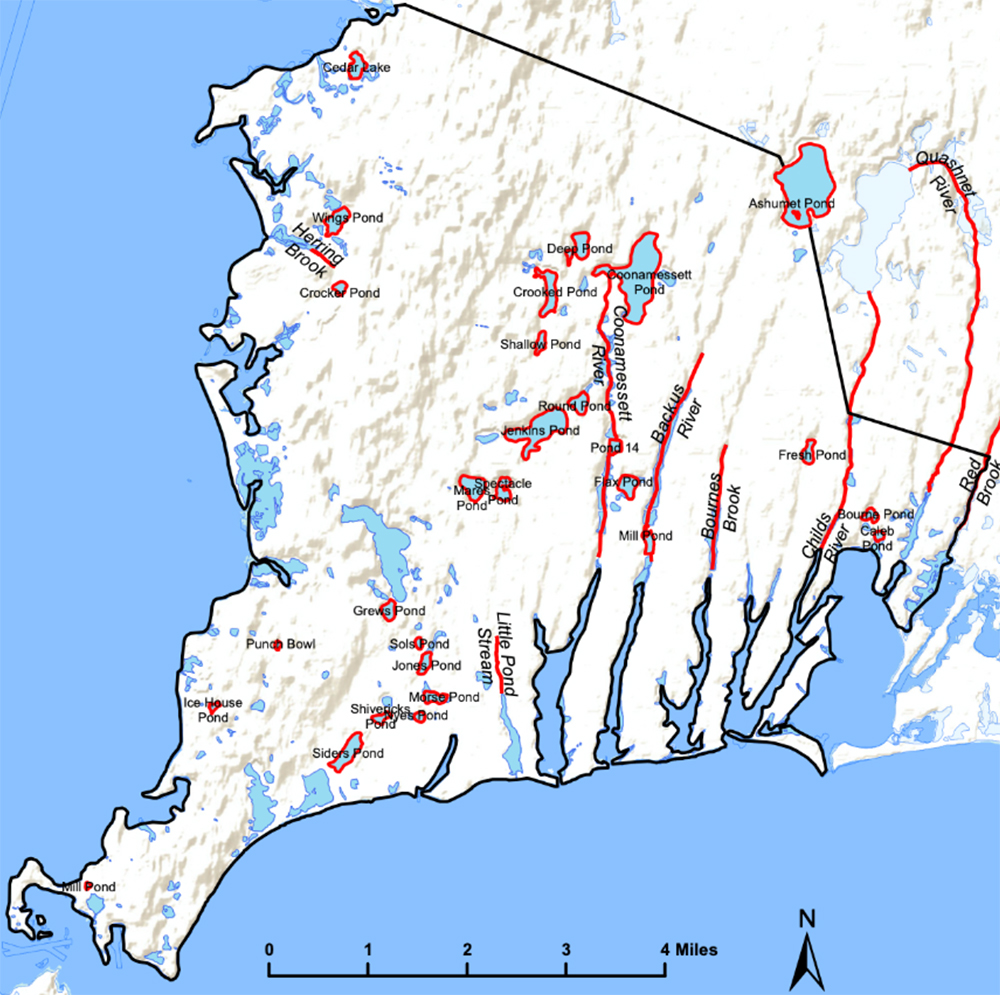
Falmouth Water Stewards received funding from the Woods Hole Foundation to survey 36 ponds, rivers, and streams in Falmouth for assessing water quality characteristics during both summer and winter. Runoff of plant nutrients (nitrogen, and phosphorus) from land degrades the quality of surface waters. These impacts include excessive growth of algae, periodic low oxygen, and blooms of potentially harmful algae. While nitrogen largely drives water quality declines in coastal salt waters, both nitrogen and phosphorus contribute to water quality decline in fresh waters.
Results from the summer sampling revealed five concerns:
(1) Nitrate is high in rivers and low in ponds; this is expected, as rivers are carrying groundwater that is enriched in nitrate from septic systems. Plankton and submersed plants growing in summer take up nitrate and ammonium.
(2) Most ponds had low levels of ammonium and nitrate (inorganic and available) nitrogen; exceptions seemed to be Siders Pond (a unique pond due to its salinity profile), and Deep Pond that had higher nitrate levels than other ponds. It is likely that pond nitrogen is mostly low but occasionally high when a phytoplankton bloom ends (it did not have particularly high chlorophyll).
(3) Some ponds were particularly notable for high chlorophyll: Wings, Punch Bowl, Shallow, and Mill ponds in Woods Hole and East Falmouth.
(4) Phosphate was low almost everywhere, but highest in the two Mill Ponds.
(5) Temperature and dissolved oxygen profiles in all but the very shallowest ponds were highly stratified and hypoxic or anoxic in the bottom water, and thermoclines were at 5 to 7 meters. In contrast, winter sampling revealed well-mixed water columns at all sites. A detailed Pond Atlas and Pond Summit 3 will provide summaries of all of the data during Fall 2024.